



The Impact of Corporate Digital Responsibility Perception on Employees Digital-intelligent Innovation Performance
-
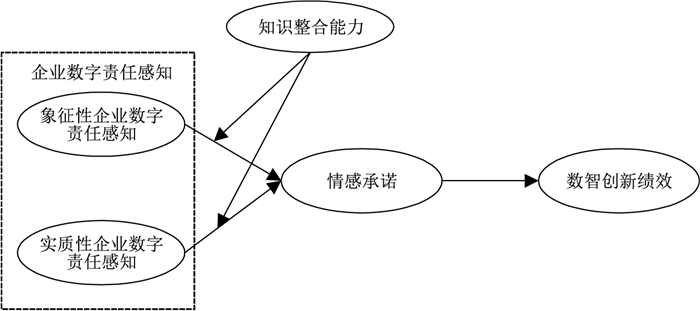
摘要: 企业数字责任是数智时代组织社会活动研究的重要议题,象征性企业数字责任和实质性企业数字责任对员工创新绩效的影响机理需深入挖掘。基于社会认同理论和线索一致性理论,通过对436份科技型企业员工的调查数据进行实证分析,构建一个有调节的中介模型,探讨企业数字责任感知对员工数智创新绩效的影响机制。研究发现:象征性企业数字责任感知和实质性企业数字责任感知对员工数智创新绩效的影响存在差异,前者影响为负,后者影响为正;情感承诺在其中起到部分中介作用,知识整合能力不仅调节了企业数字责任感知与情感承诺之间的关系,且进一步通过情感承诺影响数智创新绩效。本文拓展和深化了企业数字责任的理论边界,揭示了员工对企业数字责任差异化认知的影响结果,为企业有效履行数字责任和激发员工数智创新提供了管理实践启示。Abstract: Corporate digital responsibility constitutes an important research topic concerning organizational social activities in the era of digital intelligence. The influence mechanisms of symbolic and substantive corporate digital responsibility on employees' innovation performance remain to be thoroughly explored. Based on social identity theory and cue consistency theory, this paper conducts an empirical analysis on survey data collected from 436 employees of technology-based enterprises. A moderated mediation model is constructed to investigate the impact mechanism of corporate digital responsibility perception on employees' digital-intelligent innovation performance. The empirical results show that symbolic and substantive conception of corporate digital responsibility and corporate digital responsibility exert divergent effects on employees' digital-intelligent innovation performance: the former generates a negative effect, while the latter a positive one. Affective commitment serves as a partial mediator in this relationship. Knowledge integration capability not only moderates the linkage between corporate digital responsibility conception and affective commitment, but also indirectly influences digital-intelligent innovation performance via affective commitment. This study expands and enriches the theoretical boundary of corporate digital responsibility, uncovers the consequences of employees' differentiated perceptions of corporate digital responsibility, and offers practical management references for firms to effectively undertake digital responsibility and motivate employees' digital-intelligent innovation.
-
表 1 描述性统计结果与相关系数矩阵(N=436)
变量 1 2 3 4 5 6 7 8 9 10 11 年龄 1 性别 0.006 1 职位 0.082 -0.012 1 学历 -0.146** 0.060 0.248** 1 企业规模 0.041 0.061 -0.072 -0.019 1 企业性质 0.022 0.061 0.094 -0.028 0.094 1 象征性企业数字责任感知 0.027 0.018 0.029 0.056 0.029 0.056 1 实质性企业数字责任感知 0.015 -0.032 0.046 -0.094* -0.114* -0.094* -0.114* 1 数智创新绩效 0.001 -0.014 0.010 -0.109* -0.207** 0.548** -0.207** 0.548** 1 情感承诺 -0.079 -0.001 0.033 0.056 -0.246** 0.201** 0.258** 0.201* 0.258** 1 知识整合能力 -0.052 -0.019 0.072 -0.021 -0.043 0.093 0.111** 0.150** 0.111* 0.150** 1 均值 3.643 0.890 0.380 1.370 3.580 0.700 3.151 3.483 3.438 3.630 3.986 标准差 0.168 0.310 0.627 0.646 1.333 0.460 0.926 1.179 0.897 1.221 1.263 注:*、**分别表示P < 0.05、P < 0.01。下表同。  下载: 导出CSV
表 2 测量模型的比较(N=436)
模型 因子 χ2 df χ2/df CFI TLI RMSEA 1 五因子模型:假设模型 1 260.59 395 3.191 0.910 0.900 0.051 2 四因子模型:SCDR+BCDR、AC、DIP、KIC 2 017.94 400 5.045 0.744 0.813 0.086 3 三因子模型:SCDR+BCDR、AC+DIP、KIC 2 687.69 404 6.653 0.498 0.459 0.114 4 两因子模型:SCDR+BCDR、AC+DIP+KIC 3 299.56 407 8.107 0.364 0.320 0.128 5 单因子模型:全部合并 3 675.28 409 8.986 0.281 0.236 0.135 注:SCDR代表象征性企业数字责任感知、BCDR代表实质性企业数字责任感知、AC代表情感承诺、DIP代表数智创新绩效、KIC代表知识整合能力。
下载: 导出CSV
表 3 层次回归分析结果(N =436)
自变量 情感承诺 数智创新绩效 M1 M2 M3 M4 M5 M6 M7 年龄 -0.089 -0.080 -0.068 -0.003 0.011 0.027 0.019 性别 0.009 0.010 0.007 0.006 -0.005 -0.011 0.005 职位 -0.060 -0.071 -0.080 0.125** 0.135** 0.142** 0.125** 学历 -0.106* -0.100* -0.102* 0.066 0.083 0.086* 0.079* 企业规模 0.021 0.011 0.010 -0.004 0.001 0.023 -0.001 企业性质 0.084 0.086 0.076 -0.053 -0.066 -0.128** -0.072* 实质性企业数字责任感知 0.179** 0.169** 0.144** 0.531** 0.503** 0.493** 象征性企业数字责任感知 -0.232** -0.228** -0.217** -0.141** -0.104** -0.101* 情感承诺 0.157** 0.289** 0.140** 知识整合能力 0.125** 0.132** 0.035 实质性企业数字责任感知×知识整合能力 0.147** 0.081* 象征性企业数字责任感知×知识整合能力 -0.076* 0.005 R2 0.123 0.138 0.166 0.348 0.370 0.115 0.377 F值 7.471** 7.572** 7.664** 28.541** 27.805** 7.975** 21.324**
下载: 导出CSV
表 4 中介效应分析结果(N=436)
中介变量 效应值 标准误差 t值 P值 置信区间下限 置信区间上限 情感承诺 象征性企业数字责任感知(X)→情感承诺(M)→数智创新绩效(Y) 直接效应 -0.131 0.045 -2.904 0.003 -0.220 -0.042 间接效应 -0.062 0.016 - - -0.101 -0.036 情感承诺 实质性企业数字责任感知(X)→情感承诺(M)→数智创新绩效(Y) 直接效应 0.387 0.030 12.775 0.000 0.327 0.446 间接效应 0.029 0.009 - - 0.013 0.049
下载: 导出CSV
表 5 调节中介效应模型结果
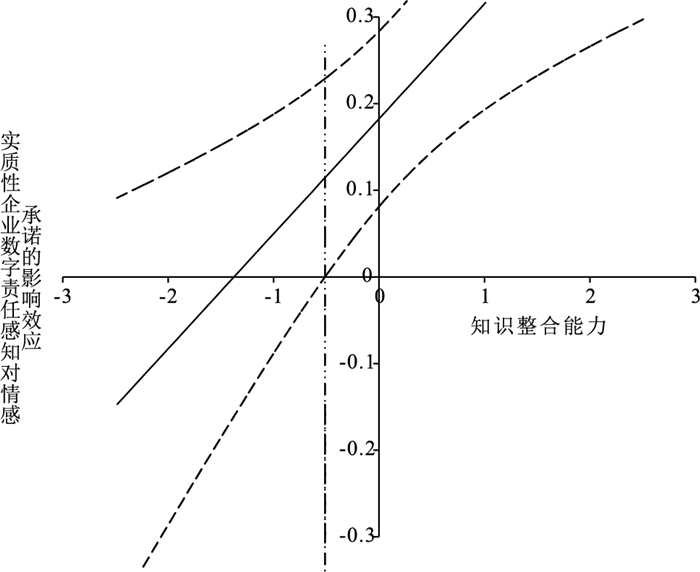
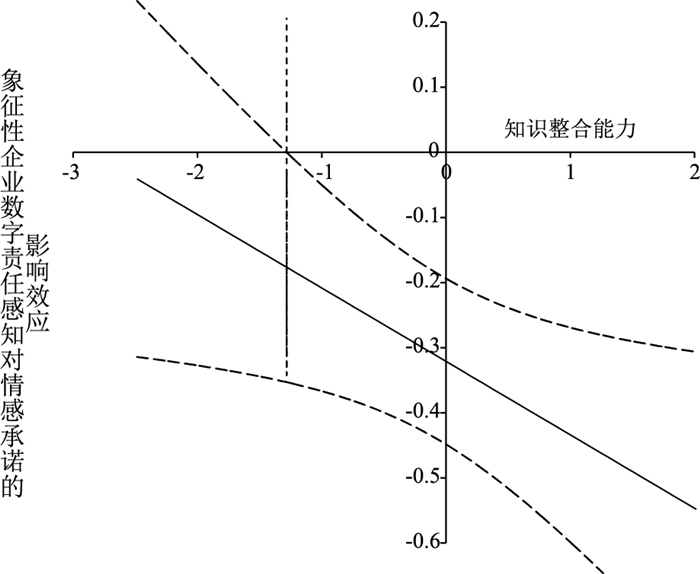
调节变量 95%置信区间 被调节的中介效应 效应值 置信区间下限 置信区间上限 效应值 置信区间下限 置信区间上限 知识整合能力 象征性企业数字责任感知(X)→情感承诺(M)→数智创新绩效(Y) 低 -0.030 -0.066 -0.004 -0.019 -0.043 -0.002 中 -0.054 -0.090 -0.029 高 -0.078 -0.129 -0.040 知识整合能力 实质性企业数字责任感知(X)→情感承诺(M)→数智创新绩效(Y) 低 0.002 -0.021 0.022 0.019 0.007 0.037 中 0.024 0.010 0.045 高 0.048 0.025 0.083
下载: 导出CSV
-
[1] 姜雨峰, 黄斯琦, 潘楚林, 等. 企业数字责任: 数字时代企业社会责任的理论拓展与价值意蕴[J]. 南开管理评论, 2024, 27(3): 245-258. [2] Lin W L. The role of corporate social responsibility and corporate social irresponsibility in shaping corporate reputation: an analysis of competitive action and innovation strategies[J]. Corporate Social Responsibility and Environmental Management, 2024, 31(2): 1451-1468. doi: 10.1002/csr.2640 [3] Jiang Y, Pan C, Han X. Age-inclusive digital responsibility: a new form of responsibility in the resonance of aging and digitalization[J/OL]. Business & Society, 2025. https://doi.org/10.1177/00076503251343124 .[4] Ashforth B E, Gibbs B W. The double-edge of organizational legitimation[J]. Organization Science, 1990, 1(2): 177-194. doi: 10.1287/orsc.1.2.177 [5] Xue S, Xu Y, Chen H. Corporate social performance feedback and corporate social responsibility decoupling in China: the salience of legitimacy and/or efficiency[J]. Corporate Social Responsibility and Environmental Management, 2024, 31(4): 3164-3180. doi: 10.1002/csr.2738 [6] Lobschat L, Mueller B, Eggers F, et al. Corporate digital responsibility[J]. Journal of Business Research, 2021, 122: 875-888. doi: 10.1016/j.jbusres.2019.10.006 [7] Donia M B L, Sirsly C A T. Determinants and consequences of employee attributions of corporate social responsibility as substantive or symbolic[J]. European Management Journal, 2016, 34(3): 232-242. doi: 10.1016/j.emj.2016.02.004 [8] Donia M B L, Ronen S, Tetrault Sirsly C A, et al. CSR by any other name? the differential impact of substantive and symbolic CSR attributions on employee outcomes[J]. Journal of Business Ethics, 2019, 157(2): 503-523. doi: 10.1007/s10551-017-3673-5 [9] Shahzadi G, John A, Qadee R F, et al. CSR beyond symbolism: the importance of substantive attributions for employee CSR engagement[J]. Journal of Cleaner Production, 2024, 436: 140440. doi: 10.1016/j.jclepro.2023.140440 [10] Nejati M, Shafaei A. Why do employees respond differently to corporate social responsibility? a study of substantive and symbolic corporate social responsibility[J]. Corporate Social Responsibility and Environmental Management, 2023, 30(4): 2066-2080. doi: 10.1002/csr.2474 [11] 毛宇飞, 胡文馨, 曾湘泉. 数智化技术应用如何影响人力资源从业者的创新绩效?[J]. 经济管理, 2024, 46(12): 81-103. [12] Tajfel H. Social categorization, social identity and social comparison[J]. Differentiation Between Social Group, 1978, 24(1): 285-295. [13] Lamata M T, Liern V, B Pérez-gladish. Doing good by doing well: a MCDM framework for evaluating corporate social responsibility attractiveness[J]. Annals of Operations Research, 2018, 267(1/2): 249-266. [14] 肖红军, 李平. 平台型企业社会责任的生态化治理[J]. 管理世界, 2019, 35(4): 120-144, 196. [15] Zhu S, Lv K, Cheng Y. The impact of digital technology innovation on firm performance: based on the corporate digital responsibility perspective[J/OL]. Business Ethics, the Environment & Responsibility, 2025. https://doi.org/10.1111/beer.12785 .[16] Rodrigue M, Magnan M, Cho C H. Is environmental governance substantive or symbolic? an empirical investigation[J]. Journal of Business Ethics, 2013, 114(1): 107-129. doi: 10.1007/s10551-012-1331-5 [17] Khattak A, Yousaf Z. Digital social responsibility towards corporate social responsibility and strategic performance of hi-tech SMEs: customer engagement as a mediator[J]. Sustainability, 2021, 14(1): 131. doi: 10.3390/su14010131 [18] Trittin-ulbrich H, Scherer A G, Munro I, et al. Exploring the dark and unexpected sides of digitalization: toward a critical agenda[J]. Organization, 2021, 28(1): 8-25. doi: 10.1177/1350508420968184 [19] Amankona d, Yi K, Tackie E A, et al. Responsible digital innovation and innovation performance in ghana's high-tech industry: the mediating roles of digital organizational culture and strategy, and the moderating role of digital literacy[J/OL]. SAGE Open, 2025. https://doi.org/10.1177/21582440251341256 .[20] Meyer J P, Allen N J. A three-component conceptualization of organizational commitment[J]. Human Resource Management Review, 1991, 1(1): 61-89. doi: 10.1016/1053-4822(91)90011-Z [21] Lee S A, Shin H H, Lee M, et al. Feelings matter in the digital age: the role of corporate digital responsibility on employee well-being and advocacy behavior[J]. International Journal of Contemporary Hospitality Management, 2025, 37(7): 2327-2348. doi: 10.1108/IJCHM-04-2024-0586 [22] Piñeros Espinosa R A. Responsible leadership and affective organizational commitment: the mediating effect of corporate social responsibility[J]. Frontiers in Psychology, 2022, 13: 868057. doi: 10.3389/fpsyg.2022.868057 [23] Raho R, Benchikh H. A Qualitative analysis of the impact of perceived corporate social responsibility on employees' affective commitment[J]. Business Ethics and Leadership, 2025, 9(1): 43-64. doi: 10.61093/bel.9(1).43-64.2025 [24] Jalali A, Jaafar M, Abdelsalam A, et al. The indirect effect of high-performance work practices on employees' performance through trust in management[J]. Journal of Facilities Management, 2023, 21(2): 242-259. doi: 10.1108/JFM-07-2021-0073 [25] García-cruz J, Real J C, Roldán J L. Managerial perceptions of employees' affective commitment and product innovation[J]. Economics of Innovation and New Technology, 2018, 27(3): 290-305. doi: 10.1080/10438599.2017.1346163 [26] Widyarini M A, Subiyanto D, Hadi S. Bridging training and competence to innovation: the role of affective commitment in driving innovative behavior[J]. Journal of Business and Management Review, 2025, 6(3): 215-234. [27] Grant R M. Prospering in dynamically-competitive environments: organizational capability as knowledge integration[J]. Organization Science, 1996, 7(4): 375-387. doi: 10.1287/orsc.7.4.375 [28] Ullah s, Ahmad T, Lyu B, et al. Integrating external stakeholders for improvement in green innovation performance: role of green knowledge integration capability and regulatory pressure[J]. International Journal of Innovation Science, 2024, 16(4): 640-657. doi: 10.1108/IJIS-12-2022-0237 [29] Moorthy S, Polley D E. Technological knowledge breadth and depth: performance impacts[J]. Journal of Knowledge Management, 2010, 14(3): 359-377. doi: 10.1108/13673271011050102 [30] Scott S G, Bruce R A. Determinants of innovative behavior: a path model of individual innovation in the workplace[J]. Academy of Management Journal, 1994, 37(3): 580-607. doi: 10.2307/256701 [31] Yin S, Zhao Y. Digital green value co-creation behavior, digital green network embedding and digital green innovation performance: moderating effects of digital green network fragmentation[J]. Humanities and Social Sciences Communications, 2024, 11(1): 1-12. doi: 10.1057/s41599-023-02237-1 [32] Xue L, Qiang L, Bing L, et al. Influence mechanism of organizational quality acquired immune on quality performance based on immune perspective[J]. Accounting and Corporate Management, 2020, 2(1): 42-55. [33] Preacher K J, Rucker D D, Hayes A F. Addressing moderated mediation hypotheses: theory, methods, and prescriptions[J]. Multivariate Behavioral Research, 2007, 42(1): 185-227. doi: 10.1080/00273170701341316 [34] Edwards J R, Lambert L S. Methods for integrating moderation and mediation: a general analytical framework using moderated path analysis[J]. Psychological Methods, 2007, 12(1): 1-22. doi: 10.1037/1082-989X.12.1.1 [35] Hayes A F, Rockwood N J. Conditional process analysis: concepts, computation, and advances in the modeling of the contingencies of mechanisms[J]. American Behavioral Scientist, 2020, 64(1): 19-54. doi: 10.1177/0002764219859633 -

 点击查看大图
图(3) / 表(5)
计量
- 文章访问数: 791
- HTML全文浏览量: 624
- PDF下载量: 25
- 被引次数: 0